What will the AI economy actually look like? More specifically: if AI takes everyone's job, who exactly is going to pay for the AI?
Strip away the jargon and an economy is just fancy bartering. At its core it answers three basic questions:
- Who produces things?
- Who consumes things?
- How do we exchange value between the two?
Adam Smith wrote about the division of labour back in 1776. The butcher, baker and brewer each specialised, became more productive, and traded with one another. Nobody needed to grow wheat, raise cattle and bake bread themselves.
Specialisation created prosperity.
Two and a half centuries later, the principle remains largely unchanged:
My spending is your income. Your spending is my income.
The scarce side of the equation is about to move
The production side has historically been the constraint. Human labour was limited, expensive and slow to scale.
The AI dream promises to change all of that. With AI doing the thinking and robotics doing the lifting, we are promised a future of near-zero production costs. Infinite productivity. Unlimited supply. Goods and services generated at a fraction of today's cost.
Great. But AI does not consume. Humans consume.
If humans no longer earn wages, who becomes the customer?
The honest answer is that in the end state, this may not matter. If production really does cost almost nothing, then prices fall too, and the question dissolves. The problem is that nobody lives in the end state. We live in the transition.
What happens during the decades in between
Elon Musk put the destination plainly at the UK's AI Safety Summit in 2023: "There will come a point where no job is needed. You can have a job if you want to have a job for personal satisfaction, but AI will be able to do everything." (CNBC, Elon Musk says AI will eventually create a situation where no job is needed)
Perhaps. But how do we get there? What happens during the decades in between?
What happens to a society where millions of people gradually lose their economic purpose faster than they find a new one? Will social systems remain stable long enough to reach that promised future?
The scale is not speculative. The IMF puts almost 40 percent of global employment as exposed to AI, rising to around 60 percent in advanced economies, where more of the work is cognitive (IMF, Gen-AI: Artificial Intelligence and the Future of Work). Exposure is not the same as replacement. But it is the pool the transition draws from.
At its core, the economy remains a mechanism for satisfying basic human needs.
History suggests that when things become difficult, humanity quickly rediscovers its priorities. In prosperous times we debate technology. In difficult times we count calories. When the shelves are empty, nobody asks for Wi-Fi. They ask where the bread is.
Everything else is just layers of abstraction built on top.
The question worth asking
The success of the AI revolution depends on human prosperity. AI can create enormous wealth, but economies run on circulation, not accumulation or concentration. The biggest question of the AI revolution should therefore not be what AI can and cannot (or should not) do. It is how we ensure that the wealth AI creates still flows through the economy.
That drift is already measurable, and it started well before AI. The share of global income going to workers has fallen by 1.6 percentage points since 2004, which sounds trivial until you convert it: workers earned roughly $2.4 trillion less in 2024 than they would have if their share had simply held. The ILO names technology as one of the drivers (ILO, Global labour income share declines putting upward pressure on inequality).
The danger lies in the next 10 to 20 years, when human labour may become economically redundant faster than scarcity disappears. People could lose wages and purchasing power long before necessities become effectively free. The machines may arrive before the abundance does.
The transition is the dangerous part.
What does not change
When the hype fades, the venture capital runs dry, and the keynote speeches are forgotten, society will rediscover a truth that has survived every technological revolution in history.
People first need a roof over their heads. People need food on the table. And they will always need security, belonging, purpose and human connection.
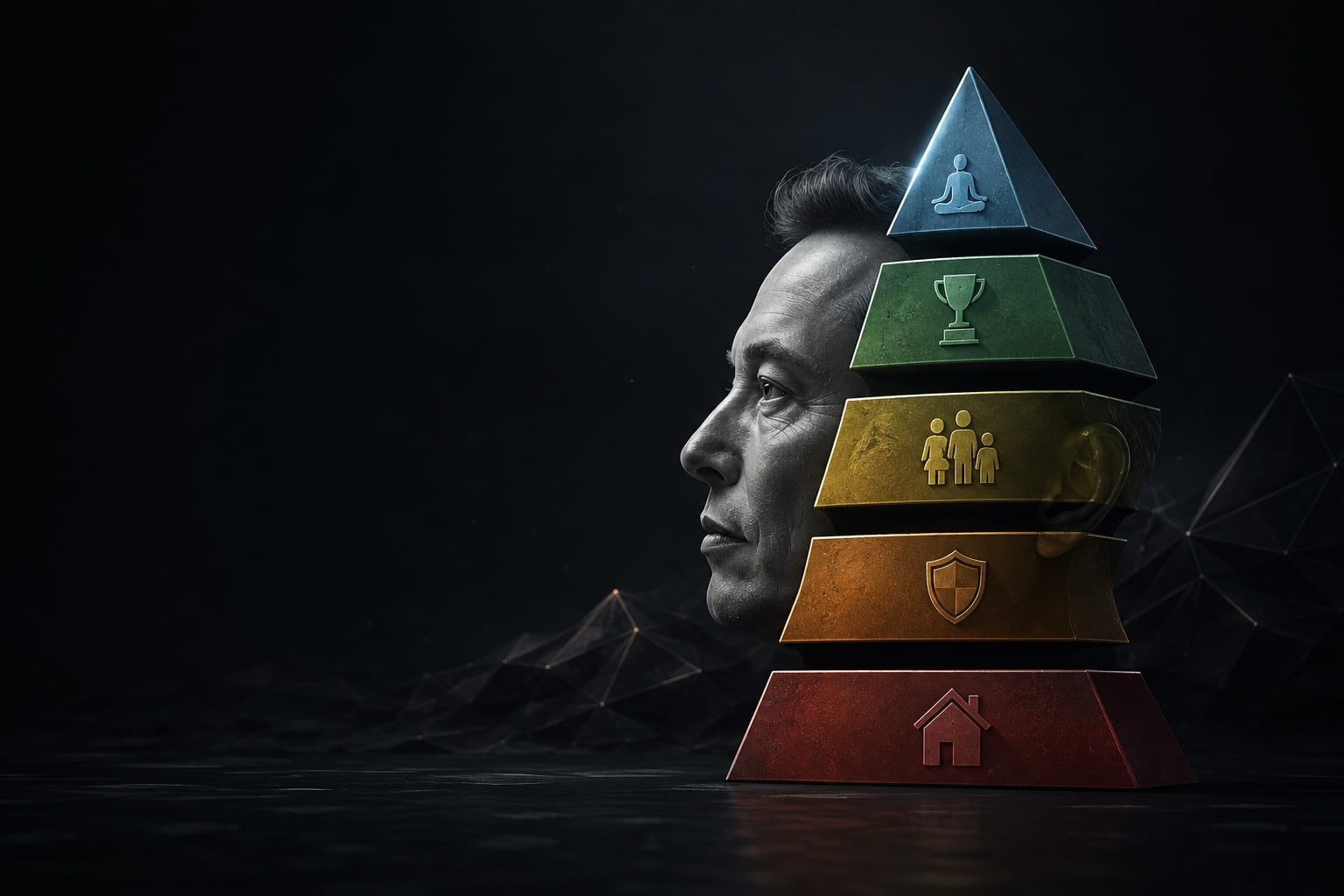
Maslow put those needs in a pyramid over eighty years ago, and while psychologists have argued about the order ever since, nobody has argued the needs away.
Technology can change how we satisfy those needs.
It cannot eliminate the needs themselves.
Maslow will always beat Musk.