
Ask an AI to write a working API endpoint and you get something usable in seconds. Ask it to name your company and you get something average. Both jobs are hard. Only one has moved.
Verifier’s Law
Jason Wei, an AI researcher at Google and then OpenAI, has a clean explanation for this. He calls it verifier’s law: how easily you can train an AI to do a task tracks how easily that task can be checked. Anything solvable and easy to check will eventually be solved by a machine. His full list runs to five properties. Three carry the working parts.
Checkable. Can it be split into steps that each get checked? A VAT calculation can. A letter of condolence cannot.
Agreement. Would two experts reach the same verdict? Two accountants agree on a trial balance. Two creative directors never agree on a logo.
Feedback. How often does proof come back? A trading desk knows by Friday. A leadership programme knows in five years, if ever.
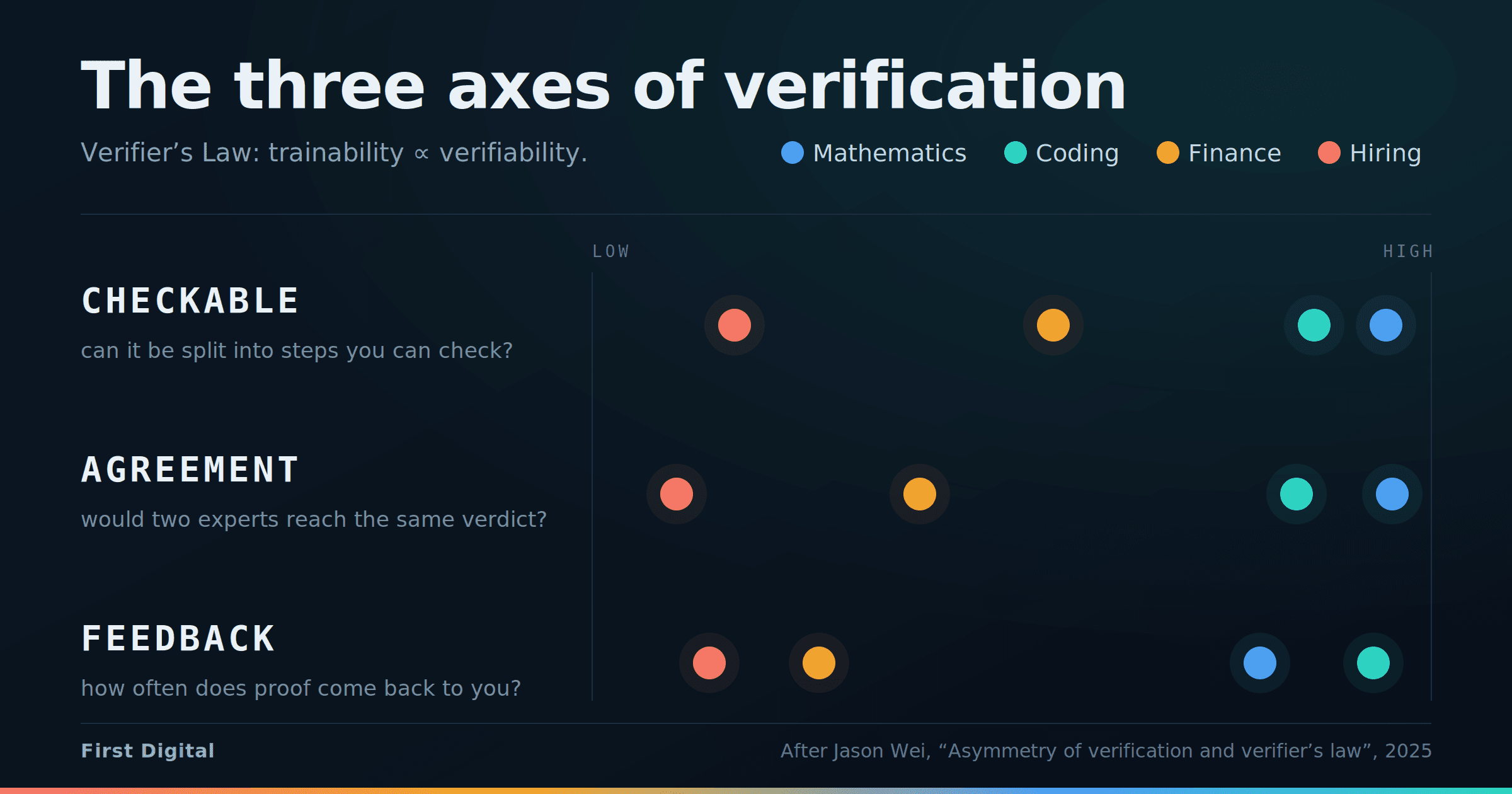
Mathematics and coding sit at the top. Hiring sits at the bottom of all three, because the judgement resists being broken down, two interviewers rarely agree, and proof arrives eighteen months later about the person you took and never about the four you turned away. Finance holds both extremes. A reconciliation is as checkable as a unit test. An investment call is as contested as a hire.
GitHub handed coding all three
Compilers, unit tests and CI pipelines break software into steps a machine grades in seconds. The build passes or it fails, and no committee gets a vote. GitHub then supplied the third axis at a scale nothing else matches: hundreds of millions of repositories carrying issues, pull requests, review comments and test results. Billions of worked examples with the answer key stapled to the back.
No other profession has that. Radiologists do not publish every scan with the eventual biopsy result attached. Lawyers do not push their negotiations to a public branch with the settlement value in the commit message. The proof exists in both jobs, and it evaporates.
Where it lands next
Financial operations, retail pricing and rules-heavy public sector work score well, because the result gets marked within days. Industrial plants move at the speed of their instrumentation. Health splits, with claims coding and scan reading on one side and treatment decisions on the other. Agriculture waits for the harvest. Guest experience, brand and hiring stay slow, because nobody agrees on what correct looks like.
Verifiability is something you build
Wei points out that you can make a task more checkable with work up front, the way test cases turn unreadable code into a pass or fail question. The same trick works in a business.
Write the answer key first. Take 200 real cases a senior person has already judged, with the reasoning. That evaluation set matters more than the model you choose.
Shorten the loop. Anything measured in quarters usually has a proxy you can measure in days.
Log the human decision. Every override and approval is training data when you capture the reason with it. Most organisations discard it.
Break the work down. A judgement call that resists checking usually contains six steps that do not.
Coding got its answer key by accident. Everyone else has to build one deliberately. That is the difference between an AI pilot that impresses a boardroom and an agent you can defend in an audit.